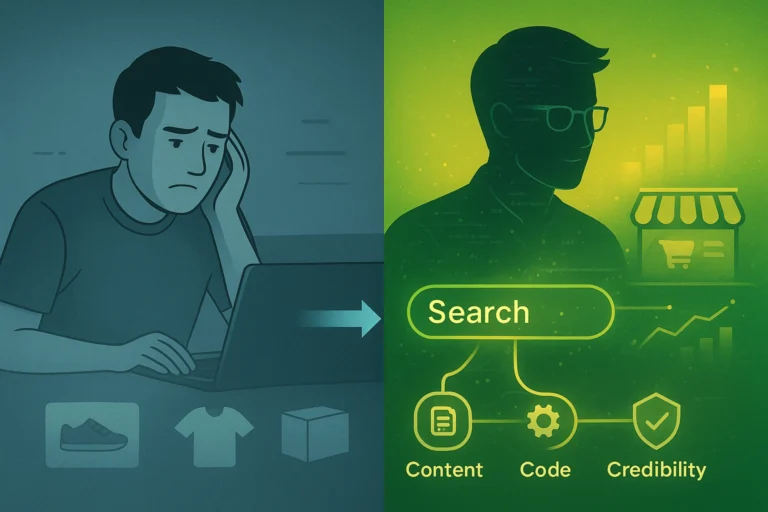
You’ve spent years optimizing for that top spot on Google, battling for every keyword and building links to climb the rankings. Then, overnight, a new competitor moves in above you: Google itself, with its AI-generated answer.
That neatly summarized block of text, known as an AI Overview, is changing the search landscape faster than any algorithm update in recent memory. For ecommerce seo agencies and brands and, it’s a jarring shift. The game is no longer just about getting clicks; it’s about getting cited.
If your products, advice, and brand aren’t being used as a source for these AI-powered answers, you risk becoming invisible. This is the new frontier of search, and it requires a new strategy: Generative Engine Optimization (GEO).
From Clicks to Citations: Why Your Old SEO Playbook Is Outdated
For years, Search Engine Optimization (SEO) was a relatively straightforward exchange. You created the best page for a query, Google ranked it, and a user clicked your link.
Generative Engines change this dynamic. They act as a synthesis layer, pulling information from multiple sources to construct a single, conversational answer. The goal is no longer just to be a top result but to be a trusted source within the result.
What is Generative Engine Optimization (GEO)?
Generative Engine Optimization (GEO) is the practice of structuring your website’s content and data to be easily understood, trusted, and cited by AI models like those powering Google’s AI Overviews, ChatGPT, and Perplexity.
Think of it this way: SEO gets you a seat at the table. GEO gets you quoted by the host. It’s about making your content so clear, authoritative, and factually dense that AI engines choose to feature your information in their generated responses.
GEO vs. Traditional SEO: A Fundamental Shift
The move from traditional SEO to a GEO-focused strategy isn’t about abandoning what works. It’s about augmenting it. The fundamentals of creating high-quality, user-focused content are more important than ever. However, the tactical focus shifts significantly.
Here’s what this means for your brand:
| Factor | Traditional SEO Focus | Generative Engine Optimization (GEO) Focus |
|---|---|---|
| Primary Goal | Rank high in the 10 blue links to earn a user click. | Get cited as a source within the AI-generated answer. |
| Content Focus | Long-form content targeting primary keywords. | Concise, “atomic facts” and clear data points within content. |
| Authority Signal | Backlinks from other websites. | Citations, brand mentions, and consensus across the web (forums, etc.). |
| Technical Focus | Crawlability, site speed, mobile-friendliness. | Deep structured data (schema), content accessibility for AI crawlers. |
| Success Metric | Organic traffic, keyword rankings, click-through rate (CTR). | Citation frequency, visibility in AI Overviews, brand impressions. |
Practical GEO Strategies for Ecommerce Brands
Adapting to GEO doesn’t require throwing out your entire marketing plan. It’s about refining your approach to content, data, and authority.
Structure Your Content for AI Comprehension
AI models don’t “read” a webpage like a human. They parse it for facts, data, and clear statements. To make your content more AI-friendly, you need to structure it for machine comprehension.
- Use Short Paragraphs: Break down complex ideas into single-thought paragraphs.
- Employ Clear Headings: Use H2s and H3s to create a logical, hierarchical structure.
- Leverage Lists: Bulleted and numbered lists are perfect for presenting features, benefits, or steps in a process.
- State Facts Clearly: Instead of “Our jackets are designed to be quite warm,” write “This jacket is insulated with 800-fill power down, rated for temperatures down to 10°F / -12°C.”
This applies everywhere, from your product descriptions and category pages to your buying guides. Every piece of content is an opportunity to provide a citable fact.
The New Role of Technical SEO and Structured Data
If clear content is the language you use to speak to AI, structured data (or schema markup) is the grammar. It’s code that explicitly tells search engines what your content is about. For ecommerce, this is a non-negotiable part of GEO.
By marking up your product pages with specific schema, you’re essentially handing the AI a spec sheet. Key schema types for ecommerce include:
- Product Schema: Defines the item’s name, brand, description, and unique identifiers.
- Offer Schema: Specifies the price, currency, availability, and sale conditions.
- Review Schema: Highlights customer ratings and testimonials, providing social proof.
- FAQ Schema: Marks up common questions and answers, making them prime candidates for inclusion in AI Overviews.
Practical Takeaway: Ensure your product data is accurate and complete. While GTINs are useful, the key is having clear unique identifiers, which might be a combination of the brand and SKU depending on your catalog. Getting this data foundation right often starts with a powerful feed management software capable of structuring and delivering this information flawlessly to search engines.
Winning the Mid-Funnel with Expert Content
Some of the biggest opportunities in GEO lie in answering the complex questions customers ask before they’re ready to buy. Queries like “best running shoes for flat feet” or “how to choose a non-toxic mattress” are perfect for AI Overviews.
This is where building topical authority through content clusters becomes critical. Instead of just one blog post, create a hub of interconnected articles, guides, and tools that cover a topic from every angle. By demonstrating deep expertise, you signal to generative engines that you are the authoritative source on that subject. This approach has been shown to drive significant traffic growth by capturing purchase-intent keywords.
The Advanced GEO Playbook: Building Unshakeable Brand Authority
True dominance in the AI search era goes beyond on-page tactics. It’s about building a brand that AI engines recognize as a legitimate, trusted entity across the entire internet.
Beyond Your Website: Why Your Brand’s Digital Footprint Matters
AI models build their understanding of the world by analyzing vast amounts of data from countless sources. They look for consensus. If your brand is consistently mentioned in positive contexts on forums like Reddit, in YouTube reviews, and by industry experts, the AI learns to trust you.
These are called brand mentions and co-citations. They signal that your brand is a real-world authority, not just a collection of well-optimized web pages.
Here’s what this means for your brand: a strong community, positive customer reviews, and genuine engagement on other platforms are no longer just “nice-to-haves.” They are becoming direct signals that influence your visibility in generative search.
AI Isn’t Replacing Strategy—It’s Amplifying It
The demands of GEO—creating factual content at scale, marking up data correctly, and monitoring mentions across the web—can seem overwhelming. The irony is that AI itself is the key to managing it.
This is where the expertise of an ecommerce SEO agency becomes crucial. Modern agencies leverage specialized AI systems to scale content creation while ensuring it aligns with your brand voice and follows proven SEO frameworks. These aren’t generic “one-click” tools; they are custom-trained agents that act as an extension of your team, capable of everything from writing SEO-friendly product descriptions to identifying optimization opportunities 24/7.
How to Know If It’s Working: Measuring GEO Success
Measuring GEO is still an emerging discipline, as the technology is constantly changing. Traditional metrics like organic rankings and traffic still matter, but they don’t tell the whole story.
To measure success in this new landscape, you need to add a few KPIs to your dashboard:
- Citation Frequency: How often is your domain cited as a source in AI Overviews for your target queries?
- Share of Voice in AI: What percentage of generative answers for your key topics mention your brand?
- Branded Search Lift: As your brand becomes a trusted source, are more people searching for you directly?
Tracking these metrics requires specialized tools and a forward-thinking approach, but it’s the only way to truly understand your performance in an AI-driven world.
Frequently Asked Questions about GEO for Ecommerce
What is Generative Engine Optimization (GEO)?
GEO is the process of optimizing your website’s content and technical structure to be easily understood, trusted, and cited as a source by AI-powered search engines like Google’s AI Overviews.
How does GEO differ from traditional SEO?
While SEO focuses on ranking web pages to earn clicks, GEO focuses on getting your information and brand featured directly within AI-generated answers. It prioritizes factual accuracy, structured data, and broad digital authority over just backlinks and keyword density.
Why is GEO important for my ecommerce store?
As more users receive answers directly from AI Overviews, the traffic to traditional organic links may decrease. If your brand isn’t cited in these answers, you lose visibility to potential customers at a critical stage of their buying journey. GEO is about future-proofing your online presence.
Can I ignore GEO and just focus on traditional SEO?
The opportunity is real, but so are the risks. Ignoring GEO is a gamble that search behavior won’t fundamentally change. While strong SEO fundamentals are the foundation of GEO, failing to adapt to the “citation” model means you’re letting competitors become the go-to source for AI engines.
What’s the first practical step I should take?
Start with your data. Conduct an audit of your product pages to ensure you are using structured data (schema) correctly and completely. Make sure your product titles, descriptions, and specifications are clear, factual, and written for easy comprehension. This is the bedrock of a strong GEO strategy.
Your Next Step in the AI-Powered Search Era
The rise of generative search isn’t an endpoint; it’s an evolution. It’s a call for brands to be more authoritative, more factual, and more helpful than ever before.
The path forward involves a dual strategy: reinforcing the SEO fundamentals that have always worked while layering in the GEO tactics that will define the future of discovery. Start by evaluating your content through the lens of an AI. Is it clear? Is it factual? Is it structured for easy understanding?
Answering these questions is the first step toward not just surviving in the age of AI search, but thriving in it.