Every eCommerce brand says they want personalization. But for most, that still means plugging a [First Name] token into a generic email blast and calling it a day.
Meanwhile, your customers are getting frustrated. In fact, a study from Segment found that 71% of consumers feel frustrated when their shopping experience is impersonal. They aren’t just ignoring one-size-fits-all marketing; they’re actively annoyed by it.
The problem isn’t a lack of desire. It’s a lack of scale. You know your VIP customers are different from your first-time buyers. You know your bargain hunters respond to different messaging than your brand loyalists. But who has the time to write five different versions of every single campaign email?
This is the central challenge of modern email marketing. And it’s where AI is changing the game—not by writing generic, robotic copy, but by giving you the power to speak to every customer segment in a perfectly on-brand voice.
The Great Personalization Gap: What Customers Want vs. What They Get
There’s a massive gap between the personalized experiences customers crave and what most brands deliver. The data tells a compelling story.
Consider this: 73% of consumers prefer to do business with brands that use personal information to make their shopping experiences more relevant, according to Digital Trends. The reward for getting this right is huge. Statista notes that personalized emails deliver 6x higher transaction rates.
Here’s the kicker: despite that incredible potential, only 39% of retailers are actually sending personalized product recommendations via email.
This disconnect is what we call “The Great Personalization Gap.” On one side, you have customers who are not only willing but eager to share their data for a better experience—83% are willing to share data for personalization (Accenture). On the other side, brands are struggling to use that data to create truly relevant conversations at scale.
Closing this gap isn’t just a “nice-to-have.” It’s becoming a requirement for growth.
Why Scaling True Personalization Is So Hard (Manually)
Let’s be honest. If you’re running a seven-figure eCommerce brand, your marketing team is already stretched thin. The manual process for deep personalization looks something like this:
- Segment Your List: Create distinct lists for new customers, repeat buyers, high AOV shoppers, cart abandoners, etc.
- Analyze Each Segment: Dig into the data. What did they buy? What did they browse? What motivates them—price, quality, newness?
- Craft Unique Copy: Write a completely different email for each segment, with tailored subject lines, headlines, body copy, and calls-to-action.
- Review and Deploy: Ensure every version is error-free and, most importantly, still sounds like your brand.
Doing this for one campaign is a monumental effort. Doing it for every weekly promotion, product launch, and abandoned cart flow? It’s nearly impossible without a massive team. This is why most brands default to the path of least resistance: a single email for everyone.
AI as a “Brand Voice Amplifier,” Not a Robot Writer
This is where the conversation around AI often goes wrong. The fear is that AI will strip the humanity out of your brand, producing generic, soulless copy. The reality is that modern AI, when used correctly, does the exact opposite.
Think of it as a tool that amplifies your strategist’s intent. Instead of replacing your marketing team, it gives them the leverage to execute the segmented campaigns they’ve always wanted to run.
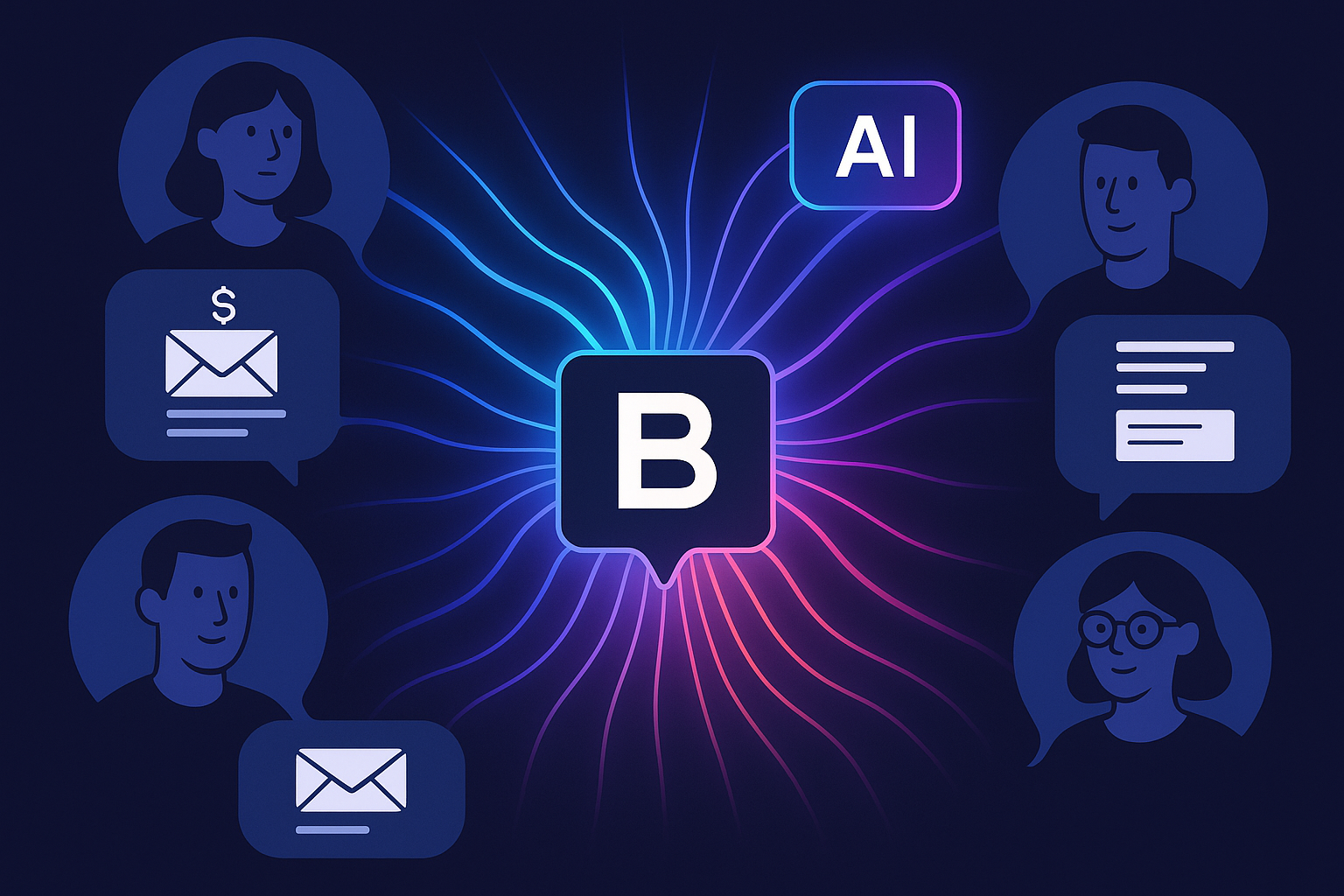
Here’s what this means for your brand: You feed the AI your core brand identity—your voice guidelines, top-performing past emails, product descriptions, and company mission. The AI doesn’t invent a new personality; it learns yours.
From there, it can instantly generate copy variations tailored to different customer mindsets. The output isn’t a final product sent directly to customers. It’s a high-quality first draft that your team can review, tweak, and approve in a fraction of the time. The tedious 80% of the writing is handled, freeing up your team to focus on the strategic 20% that makes a campaign truly special. This level of sophisticated automation is often handled by dedicated systems known as AI agents for ecommerce, which are designed to integrate brand knowledge with marketing execution.
How It Works: One Campaign, Three Different Voices
Imagine you’re launching a new line of premium, sustainable winter coats. You have three key segments to target. Manually, this would be a headache. With a brand-trained AI, it looks like this:
Core Message: We have new winter coats.
Segment 1: The Bargain Hunter (Responds to value and discounts)
- AI-Generated Subject: Your Warmest Winter Ever, Now 15% Off
- AI-Generated Copy: “Don’t let the cold drain your wallet. Our new eco-friendly winter coats are built to last a decade, not just a season. Get launch pricing for a limited time and invest in warmth that pays for itself.”
Segment 2: The Brand Loyalist (Responds to newness and brand story)
- AI-Generated Subject: It’s Here: The Collection You’ve Been Waiting For
- AI-Generated Copy: “You’ve been with us on this journey, and we’re thrilled to finally share our latest innovation. The new winter coat collection uses the recycled materials you love, now with an upgraded thermal lining. Be the first to experience it.”
Segment 3: The First-Time Buyer (Needs trust and brand introduction)
- AI-Generated Subject: A Warmer Welcome from [Your Brand]
- AI-Generated Copy: “Choosing the right winter coat is a big deal. At [Your Brand], we believe in quality that’s kind to the planet. Explore our new collection and see why thousands of customers trust us to keep them warm, season after season.”
Notice the brand voice remains consistent—focused on quality and sustainability—but the angle is completely different for each audience. That’s the power of on-brand, AI-driven personalization.
Your Questions About AI and Email, Answered
For those new to this, it’s natural to have questions. Here are some of the most common ones we hear.
What’s the difference between this and just using a tool like ChatGPT?
Generic tools like ChatGPT are incredibly powerful, but they don’t know your brand. They lack your sales data, customer history, and unique voice. A dedicated eCommerce AI is trained specifically on your brand assets, ensuring the copy it produces is relevant, accurate, and consistently on-brand.
How does the AI actually learn my brand’s voice?
It analyzes everything you give it: your website copy, your best-performing ad campaigns, past newsletters, brand style guides, and even customer reviews. It identifies patterns in tone, sentence structure, and vocabulary to create a model of how your brand communicates.
Will my emails sound robotic?
Not with the right process. The goal of AI in this context is not to “fire and forget.” It’s to produce a high-quality first draft. A human-in-the-loop approach—where a marketer gives the final approval—ensures the end result has the polish and nuance that builds customer relationships. AI handles the scale; you maintain the quality.
Is this difficult to set up and manage?
While the underlying technology is complex, the tools designed for marketers are becoming increasingly user-friendly. The best platforms are built to be managed by marketing teams, not engineers. The setup involves “feeding” the system your brand information, and from there, specialized AI agents for ecommerce can handle the day-to-day task of generating and segmenting copy.
The Future is Personal—and On-Brand
The data is clear: personalization is no longer optional. As McKinsey points out, AI in email marketing can increase revenue by as much as 25%. Brands that continue to send one-size-fits-all messages will be actively frustrating their customers and leaving significant revenue on the table.
The opportunity is real, but so are the risks of doing it wrong. AI isn’t a magic button that replaces strategy—it’s a tool that amplifies it. By embracing AI to scale your personalization efforts, you can finally close “The Great Personalization Gap,” creating more relevant experiences for your customers and driving better results for your business, all without sacrificing the unique voice you’ve worked so hard to build.