You’ve done everything right. You sourced amazing products, built a beautiful Shopify store, and even wrote a few blog posts. But when you check your analytics, you hear crickets. Your brand is a ghost town in Google’s search results, completely invisible while competitors seem to be everywhere.
If this sounds familiar, you’re not alone. The old SEO playbook of “write a blog post for a keyword” is officially obsolete. In a world of AI Overviews and smarter search engines, winning organic traffic isn’t about tricking algorithms. It’s about becoming the most trusted, authoritative resource in your niche.
Here’s what this means for your brand: You need to master a concept Google calls E-E-A-T. And surprisingly, the key to doing it at scale lies in the very technology that’s changing the game: Artificial Intelligence.
What Are We Even Talking About? E-E-A-T and Topical Authority in Plain English
Let’s cut through the jargon. These concepts are simpler than they sound.
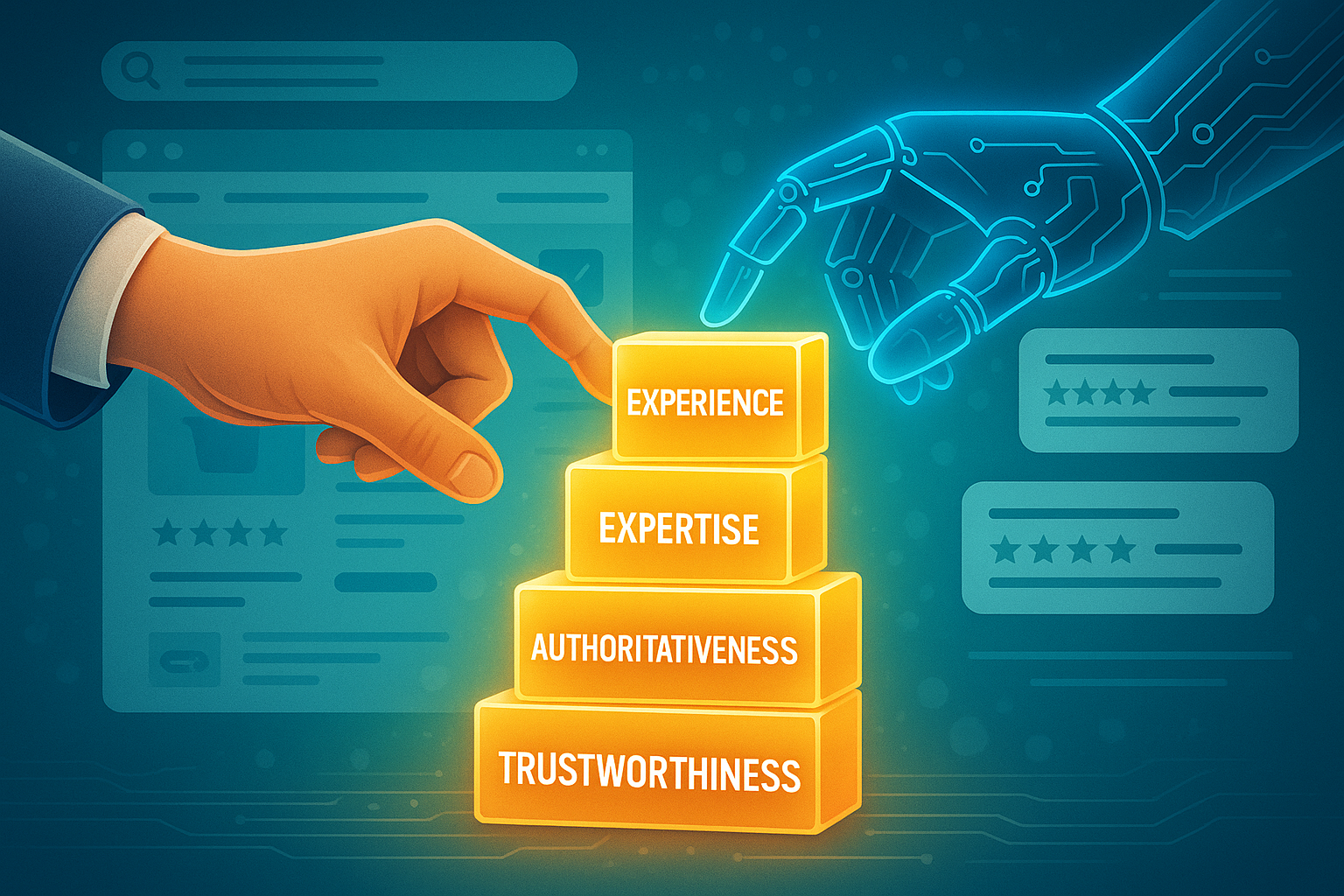
E-E-A-T stands for Experience, Expertise, Authoritativeness, and Trustworthiness. Think of it as Google’s framework for judging content quality.
- Experience: Do you have real, first-hand knowledge? Did you actually use the product or solve the problem you’re writing about?
- Expertise: Are you a subject matter expert? Do you have credentials, qualifications, or deep knowledge in this area?
- Authoritativeness: Are you the go-to source for this topic? Do other experts cite you and recognize your leadership in the space?
- Trustworthiness: Is your site secure? Are your policies clear? Can people trust the information you provide to be accurate and honest?
Topical Authority is the result of mastering E-E-A-T. Imagine your favorite bookstore. You don’t go there for just one book; you go there because you trust their entire section on a topic you love, whether it’s science fiction or cooking. Topical authority is about becoming that trusted section for your niche online. When Google sees you as the definitive resource on “specialty coffee brewing” or “sustainable skincare,” it rewards you with visibility across hundreds of related searches.
This isn’t just an SEO trend; it’s a fundamental shift. As Google’s own guidelines emphasize, the goal is to create “helpful, reliable, people-first content.” In the age of AI-powered search, this is non-negotiable.
The Big Misconception: Can AI Really Create E-E-A-T Content?
This is the most common question we hear, and it’s a fair one. How can a machine, which has no real-world experience, create content that demonstrates it?
The answer lies in a crucial mindset shift. AI isn’t replacing your strategy—it’s amplifying it.
Google has been clear: they reward quality content, not the method used to create it. Low-quality, generic AI content will fail, just as low-quality human content has always failed. But when you use AI as a tool to scale your genuine human experience and expertise, it becomes a powerful competitive advantage.
The human is the strategist, the editor, and the source of truth. The AI is the tireless assistant that handles the heavy lifting of research, drafting, and structuring. This partnership is the key to winning.
The E-E-A-T AI Workflow: A Practical Framework for eCommerce Brands
Forget blank-page paralysis and generic AI outputs. A structured workflow ensures every piece of content is infused with your brand’s unique authority.
Step 1: The Human-Led Strategy Brief
Before you write a single prompt, you define the “why.” This is where your human expertise is irreplaceable. Your brief should include:
- The Goal: What business objective does this content serve? (e.g., “Explain the benefits of our merino wool for winter hiking.”)
- The Audience: Who are you talking to, and what is their biggest pain point?
- Unique Experience: What unique data, customer stories, or internal testing results can we include that no one else has? This is your E-E-A-T goldmine.
Step 2: AI-Powered Content Scaffolding
With a strong brief, you can now direct your AI. Task it with creating a detailed outline, synthesizing initial research from trusted sources, and structuring the article with clear H2s and H3s. This saves hours of manual work.
Step 3: The Human “Experience” Infusion
This is where you transform a generic draft into authoritative content. You or your team must layer in the unique insights from your brief.
- Add real stories: “A customer in Alaska told us our socks kept her feet warm at -10°F during her daily dog walks.”
- Insert proprietary data: “In our lab tests, our fabric wicked moisture 50% faster than standard cotton.”
- Show, don’t just tell: Embed a video of your product in action or include original photos from your testing.
Step 4: Expert Review & Refinement
Every piece of content, especially technical or health-related content, must be reviewed by a genuine expert. This person validates the accuracy of all claims, adds nuanced insights the AI missed, and lends their credentials to the piece. This step is critical for building trust.
Step 5: Publishing with Purpose
Once the content is polished, use AI to assist with on-page SEO. It can help generate meta descriptions, suggest schema markup for products or FAQs, and identify internal linking opportunities to build your topical cluster.
Making E-E-A-T Tangible: AI-Assisted Tactics for Each Pillar
Let’s break down how this workflow applies to each part of E-E-A-T.
[Image: A four-quadrant graphic showing AI tactics for each of the E-E-A-T pillars in an eCommerce context.]
Experience (The “E”): Proving You’ve Walked the Walk
Generic content says, “This product is great.” Experience-driven content says, “We put this hiking boot through 50 miles of rocky terrain, and here’s how the sole held up.”
- AI Tactic: Use AI tools to analyze thousands of your customer reviews and support tickets. Prompt it to identify the top 5 real-world benefits and the 3 most common problems customers solve with your product. Weave these true user experiences into your content.
Expertise (The second “E”): Showcasing Your Deep Knowledge
Expertise goes beyond product specs; it’s about demonstrating a deep understanding of your customer’s world.
- AI Tactic: Record a 15-minute conversation with your lead product developer. Use an AI transcription tool to get a full transcript, then ask a separate AI to “summarize the key insights and pull out 3 expert quotes” to feature in your article.
Authoritativeness (The “A”): Becoming the Go-To Source
Authority is built over time by creating a web of interconnected, high-value content.
- AI Tactic: Ask your AI to “act as an SEO content strategist and create a pillar page and topic cluster outline for ‘organic dog food’.” It will map out the central guide (the pillar) and all the supporting articles (“best organic food for puppies,” “how to read dog food labels”) you need to own the topic.
Trustworthiness (The “T”): Building a Foundation of Credibility
Trust is the bedrock of eCommerce. It’s built through transparency, security, and accuracy.
- AI Tactic: After your content is written, use a prompt like: “Review the following article and identify any claims that need a citation or source. List them out.” This forces you to fact-check and link to reputable sources, boosting your credibility.
Beyond the Blog: Scaling Authority Across Your Entire Site
Topical authority isn’t just for blog posts. Your product and category pages are crucial pieces of the puzzle. Imagine trying to manually rewrite 5,000 product descriptions to include real-world use cases and expert tips. It’s an impossible task.
This is where automation becomes essential. Custom-trained ai agents for ecommerce can learn your brand voice, understand your E-E-A-T principles, and apply them at scale. They can enrich product descriptions with insights pulled from reviews, generate helpful FAQs for category pages, and ensure your entire site communicates a consistent message of expertise and trust.
Frequently Asked Questions About AI and E-E-A-T for eCommerce
What is Google’s official stance on AI-generated content?
Google rewards helpful, reliable, people-first content, regardless of how it’s created. Their focus is on the quality of the output, not the tools used. Spammy, low-value AI content will be penalized, just like spammy human content.
How can a small eCommerce store without a famous expert build E-E-A-T?
Your “experience” is your superpower. You have direct access to customer feedback, product testing data, and your own founding story. Use AI to help you tell these authentic stories effectively. You don’t need a PhD; you just need to demonstrate you know your products and customers better than anyone else.
Will AI replace my content team?
No. AI will transform their roles. Instead of spending 80% of their time on drafting and 20% on strategy, they can flip that ratio. Your team will become strategists, editors, and prompt engineers who guide AI to produce high-quality content at a scale that was previously unimaginable.
How do I measure the success of my E-E-A-T content?
Look beyond simple keyword rankings. Track metrics like:
- Branded search volume: Are more people searching for your brand name?
- Time on page: Are readers engaging with your in-depth content?
- Conversion rate from blog posts: Is your educational content leading to sales?
- Number of keywords a single page ranks for: A sign of topical relevance.
Your Next Step: From Learner to Leader
Building topical authority with AI-enhanced E-E-A-T content isn’t a quick hack; it’s a long-term strategy for building a defensible brand in the new era of search. The opportunity is real, but it requires a new way of thinking.
Start small. Pick one of your most important products or categories. Use Google’s simple “Who, How, and Why” framework to audit your existing content.
- Who created it? Is their expertise clear?
- How was it created? Does it show evidence of real experience?
- Why was it created? Is its primary purpose to help the reader, not just to rank?
By integrating human expertise with AI’s incredible scale, you can stop chasing algorithms and start building a library of content that serves customers, builds trust, and drives sustainable growth. This comprehensive approach is foundational, and for many brands, the next step involves ensuring their product listings themselves are perfectly optimized. Often, the work of a dedicated google shopping seo agency is crucial for aligning these broader content strategies directly with product feed performance to maximize visibility where it counts most.